
Why 500,000 Gamers Are Hunting 16 People?
Sweet, sweet baby.


This building behind me is home to a tiny studio of just 16 people - and 500,000 gamers want them gone, like it’s public enemy number one. I’m talking about Sweet Baby Inc., one of many consulting firms that help big game studios make their stories more inclusive. Like giving Spider-Man a deaf girlfriend, or adding a Black character into Viking lore. Thing is, those modern adjustments don’t always fly well with players, who straight-up boycott those games. And to really make sure they don’t accidentally play one, there’s a curator list tracking every single Sweet Baby game… with 500,000 followers.
Now, if that many gamers turn on you, naturally, it gets ugly.
Hateful comments, angry tweets, and even death threats. And the games? Dead on arrival. We’re talking millions down the drain, studios going dark, and quiet cancellations. And the publishers? They pretend it never happened.
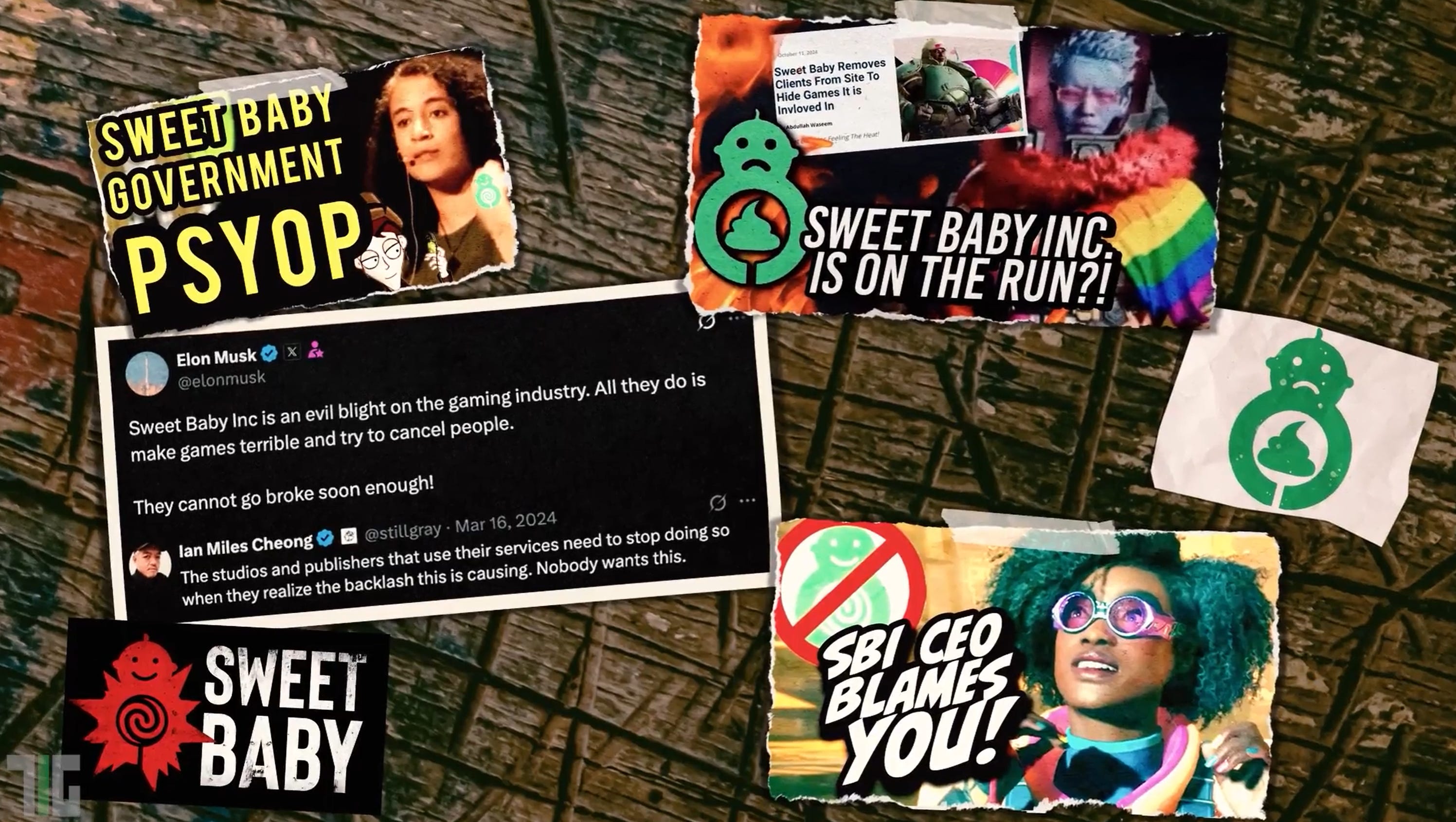
And here’s the part that doesn’t add up. If so many Sweet Baby games spark backlash, why are they still in business? Why do publishers keep paying them millions for something players seem to reject?
Well, maybe it’s because these games were never meant to please you - but to protect publishers from something more dangerous than bad reviews: A system that forces publishers to chase two masters — investors who want one thing, and gamers who want the opposite. And the result? Games stuck in a tug-of-war.
So if you want to understand why 500,000 gamers are fighting Sweet Baby Inc., let me show you the system behind it. One that everyone talks about but few actually understand.
And it all started with a quiet little UN report from 2004.
The Invisible Enemy
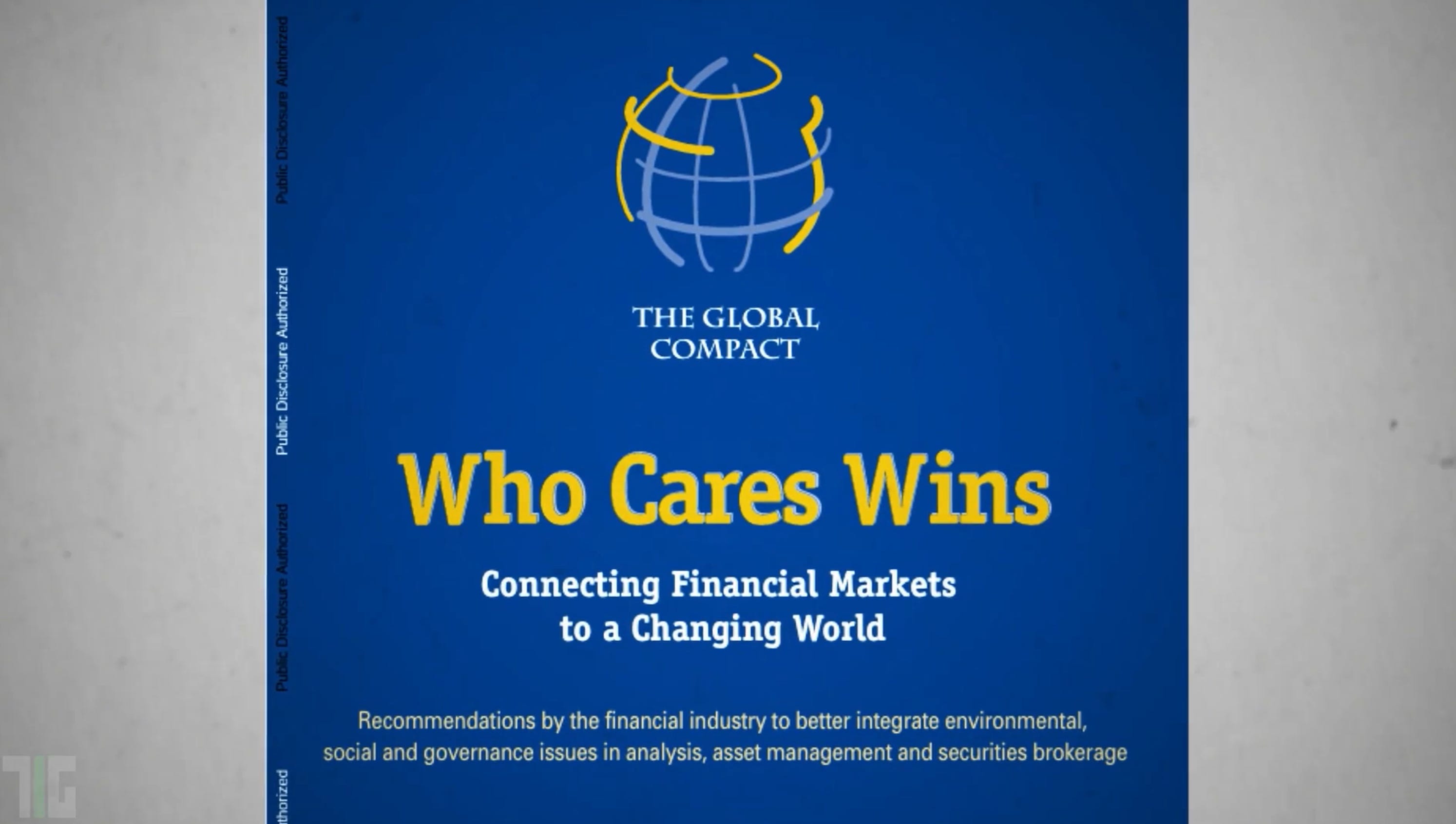
In 2001, something happened that would eventually decide which video games get made and which get cancelled.
But it had nothing to do with gaming. It had to with Enron - a $75 billion energy firm. Everyone had money in it — mostly pensions. But behind the scenes, Enron was - just like everyone else on Wall Street, hiding billions in debt and lying about profits. When the truth came out, it collapsed in the biggest bankruptcy America had ever seen.
$74 billion in value — gone. Including the pensions of 20,000 employees.
And that was just the start. The dominos fell and one company after the other was caught in the act. Fake earnings, stolen cash, and hidden debts. This wasn’t just bad PR. It was systemic. And people started asking: what are these companies actually doing with our money?
So in 2004, the UN had an idea. A weird one.
What if we gave companies a ‘good person’ score? Not just profits—but three simple questions:
Do you pollute?
Do you exploit workers?
Are you corrupt?
They called it ESG. Environmental, Social, Governance.
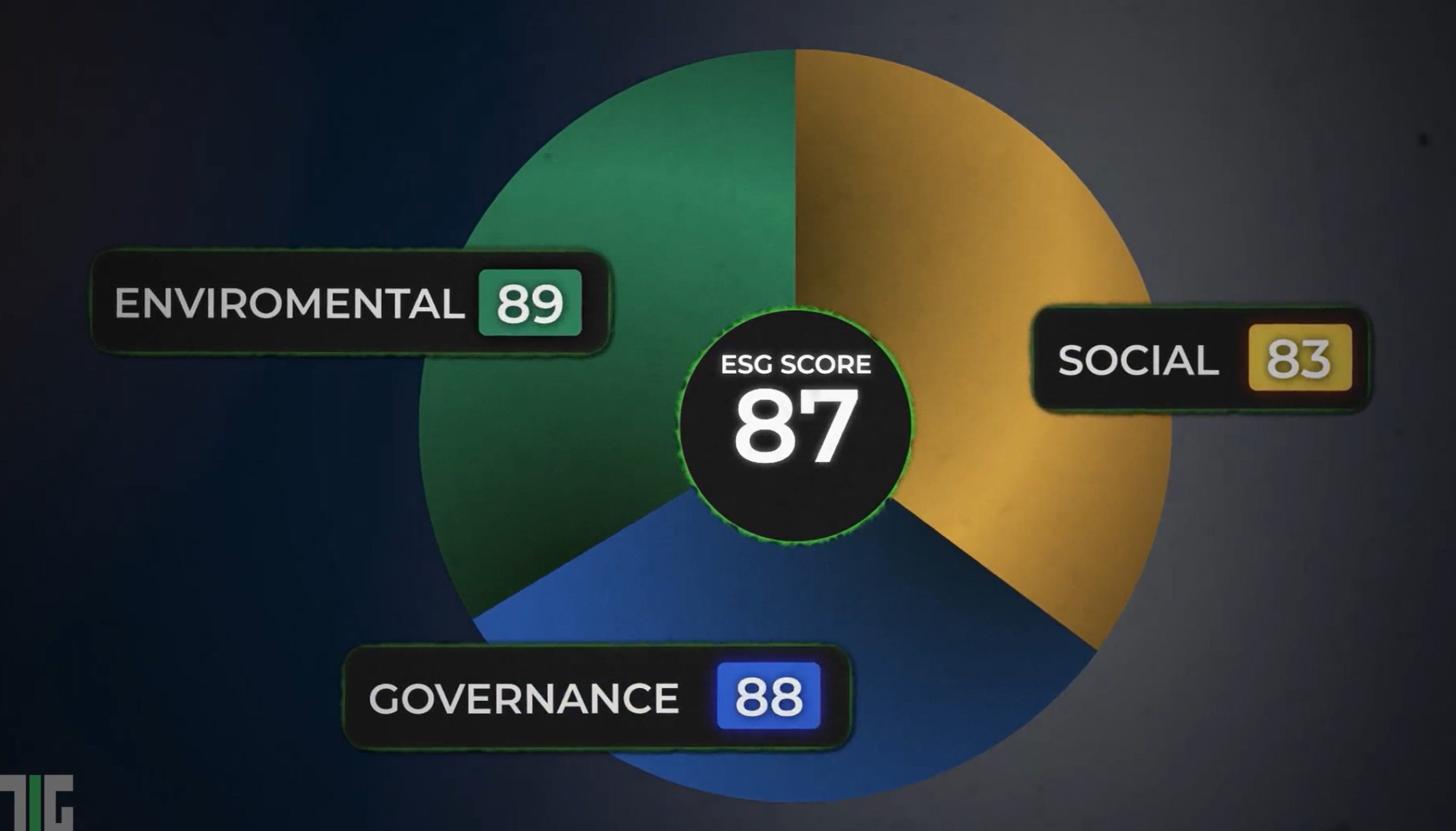
Not a save-the-world mission, but a avoid-the-next-Enron mission. Risk management 101. But for years, it was just a PDF that no one read.
Until 2008…
*show these images in a fast-paced manner with some interesting sfx
*the song pauses here, no music. it’s about tension, tension, tension.
Images
The banks burned. Again. This time taking entire countries with them. Public trust collapsed. Banks weren’t just in trouble - they were the greedy villains. And that’s when BlackRock—think of them as the final boss of money—saw an opportunity: ‘Nobody trusts banks anymore. But what if we become the ethical bank, one that says we care - AND prints money?’
Suddenly, that forgotten PDF was now BlackRocks’ new brand. If you wanted BlackRock’s money—and everyone needs BlackRock’s money—you needed a high ESG score. Just like that, three letters nobody cared about became the most powerful force in business. Including video games.
THE NEW RELIGION
But how does that bring us to a tiny consulting firm in Montreal? Well, here’s where it gets even more interesting.
This new ESG-religion wasn’t just for banks. By 2020, it spread across every industry like wild fire. From HR, retail, film and the military - everyone suddenly chasing the same invisible god:
the ESG score.
Square Enix even went so far to create an entire ‘Ethics Department.’ Their first decision? “Restrict” Tifa’s lovely D-cups. Because apparently, D-cups look “unnatural” during actions scenes.
And that was just the beginning. When COVID hit, ESG found its perfect storm: George Floyd. Black Lives Matter. #MeToo… one after another, like dominoes perfectly timed. And gaming companies watched this tsunami coming and panicked. Xbox rolled out their “Product Inclusion Framework.” Nintendo started appointing “diverse” board members. Activision, Sony, Ubisoft - everyone suddenly showing ESG slides to investors like kids showing report cards to parents.
But here’s the problem: Nobody actually knew what the hell ESG meant. You see, companies weren’t allowed to define what the “E” or the “S” truly meant. That power belonged to rating agencies who mixed everything together like a cursed smoothie. Save the whales? That’s worth points. Hire more women? Also points. Reduce carbon? Points. It made no sense. Publishers were drowning in rules they didn’t understand, terrified of losing their ESG score and BlackRock’s money. So they did what every panicking executive does: They hired consultants. An army of them. Sensitivity readers. Diversity officers. Narrative consultants. People whose entire job was to bulletproof games from Twitter mobs and protect that precious ESG score.
Which is exactly what brings us to a tiny consulting firm here in Montreal.
THE BABY FORMULA
“Hello, I’m Kim Belair. In my circles, I’m largely considered, I think, a relatively nice person. These are my dogs, Sage and Flaky. These are my cats, Tag and the Grey Boy. I really enjoy Lego. I collect skulls and taxidermy. And I also really like playing a lot of video games, including Elden Ring. By day, I am the crazed CEO of Sweet Baby Inc., the DEI-obsessed censorship mafia who is currently ruining and woke-ifying all of the video games that you’ve ever played.”
That’s Kim after getting death threats for years. But let’s rewind to 2019. To when she was just a writer with a chip on her shoulder.
Growing up, all she wanted was to write stories about people like her. People that weren’t white. But during high school she was told that her stories weren’t the “right” stories. That only white male stories were counted as literature. So for years, she adapated.
“And I did that for years… I spent like actual actual years just writing about white men.”
Eventually, she broke out and built Sweet Baby Inc, promising to help studios tell more diverse stories. On paper, a noble mission.
But here’s where noble turned tactical. Her strategy of going about it wasn’t to inspire change, but to force it:
“Go have a coffee with your marketing team and just terrify them with the possibility of what’s going to happen if they don’t give you what you want.”
Terrify them with exactly what publishers were afraid of the most: Losing their ESG scores. With headlines that could tank their stock price.
So they paid up and Sweet Baby landed big name clients with big blockbuster games. Not to tell better stories, but to bulletproof their launch from stock-tanking headlines.
But bulletproofing launches wasn’t enough for Sweet Baby. They wanted to reprogram the entire gaming audience.
“We cater them the way that we cater to like a picky baby - we feed them the same thing that we know that they love and we keep on feeding it. Here you go, eat this, eat this, eat this”
That was the pivot. Gamers weren’t fans anymore—they were obstacles. And Kim’s job was to reeducate them. Even if it meant rewriting the rules of reality.
“I once worked on a project where they had an all-white cast. They said, ‘Okay, let’s mix it up. How about this character’s stereotypically French?’ So I said, ‘Can we at least make them a person of color?’ And they said, ‘Oh no, that would be weird. They’re already French.’”
That was the crusade. Making French people… not white. To gamers, this wasn’t consulting anymore. It was ideological enforcement.
And Sweet Baby’s employees only confirmed it - openly calling to “burn the games industry to the ground” or “to shoot down white male lead game ideas.”
Kim might not have endorsed those tweets. But by then, it didn’t matter. The mask had slipped. Because now, the question wasn’t what publishers were making— it was who they were protecting themselves from. Certainly not angry gamers. But angry shareholders.
But here’s the thing about serving two masters: Eventually, you lose both. And gamers? They were about to show everyone what 500,000 angry customers could do.
PICKY BABIES PICKING BACK
The response was instant. And brutal. Every game Sweet Baby touched became a battlefield.
Starting with Alan Wake 2. A new Black female lead was introduced. And gamers lost their minds, blaming Sweet Baby. Remedy’s creative director however denied it outright, saying she was always meant to be Black. But it didn’t matter. Despite having sold over 2 Million copies, Alan Wake was no longer Alan Wake, but Alan Woke.
Then came Spider-Man 2. Miles dating a deaf girlfriend. A Pride flag. And while the game itself was solid, the story felt like it had other priorities: Representation. Representation. Representation. And once again, Sweet Baby Inc. was in the crosshairs, maybe not for the pride flag - that was Insomniacs doing - but for everything else.
But nothing - NOTHING - compared to the Suicide Squad disaster. Years of development. Hundreds of millions in budget. But only remembered for one thing: Mrs. Freeze. She was gender-swapped.
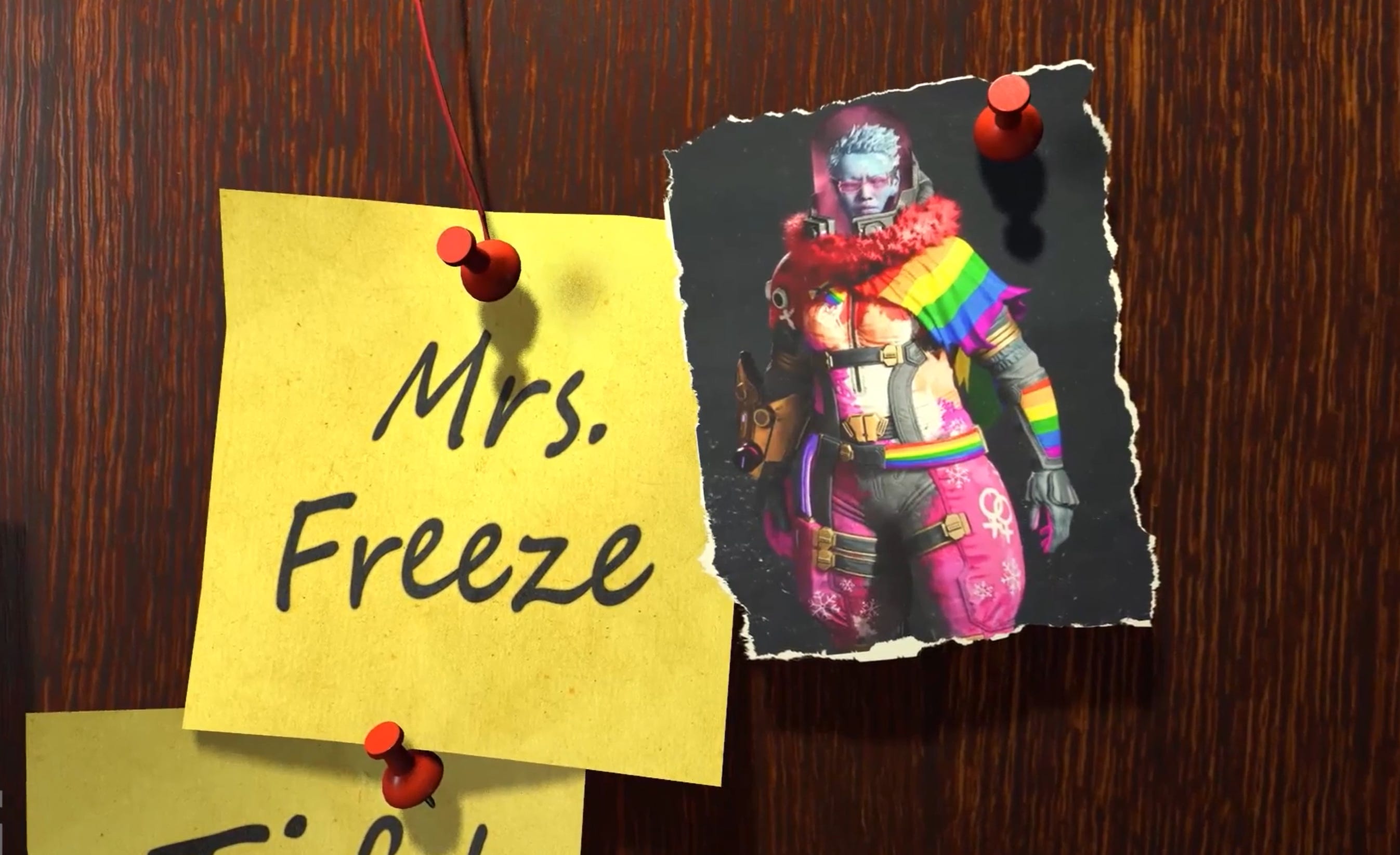
She wore a kindergarten Pride outfit. And almost overnight, Mrs. Freeze became the rainbow ice queen of inclusion.
Sweet Baby didn’t even design the character, but - again - it didn’t matter. They were guilty by association.
But here’s where things got murkier. Because even when Sweet Baby wasn’t involved, the same pattern emerged. Over and over and over again.
“Sooo I’m non-binary” - “What does that mean?” - “It means that I don’t feel like a man or a woman.”
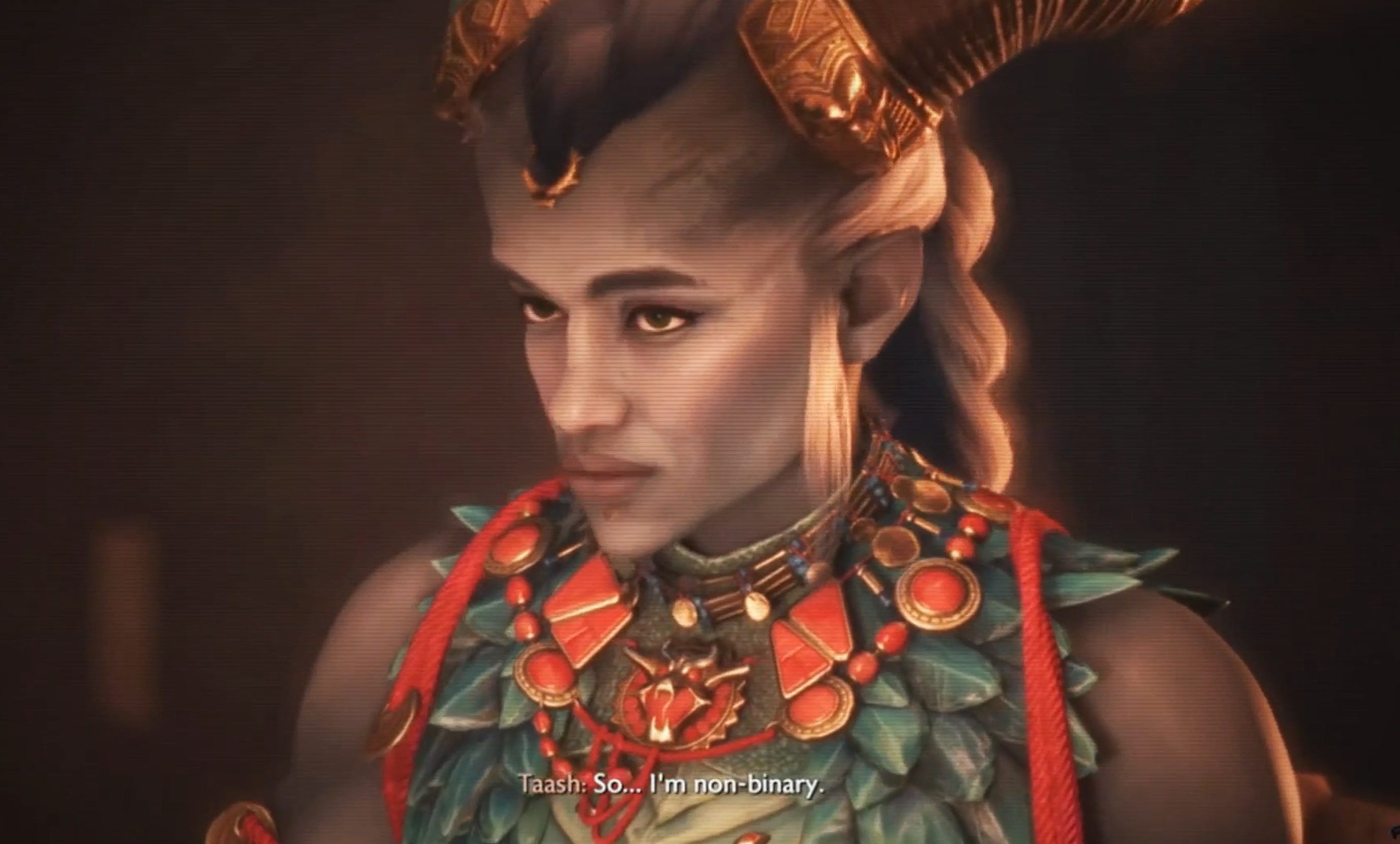
Dragon Age. Concord. Forspoken… Square Enix’s $100 million disaster that sold SO badly, their president had to apologize to investors, for “its sales have been lackluster.”
It was always the same pattern: Checkbox diversity + preachy dialogue = dead game.
But despite the pattern, publishers kept doubling down. Why?
“The way games are funded, you don’t use your own money. Even EA, its games are hugely expensive to make—they’re upwards of, you know, 250, sometimes 600 million dollars. It’s for certain live games, it’s incredibly how expensive they are. And to do that, uh, your CFO is your best friend.”
When a game costs more than a Hollywood blockbuster, you stop caring what players want. You care what investors want. And investors wanted those ESG points.
So gamers did what gamers do. They get organized.
In February 2024, the infamous Sweet Baby Inc. Detected list launches on Steam. A simple list. Not to harass, but to inform. Like an ingredient label on food.
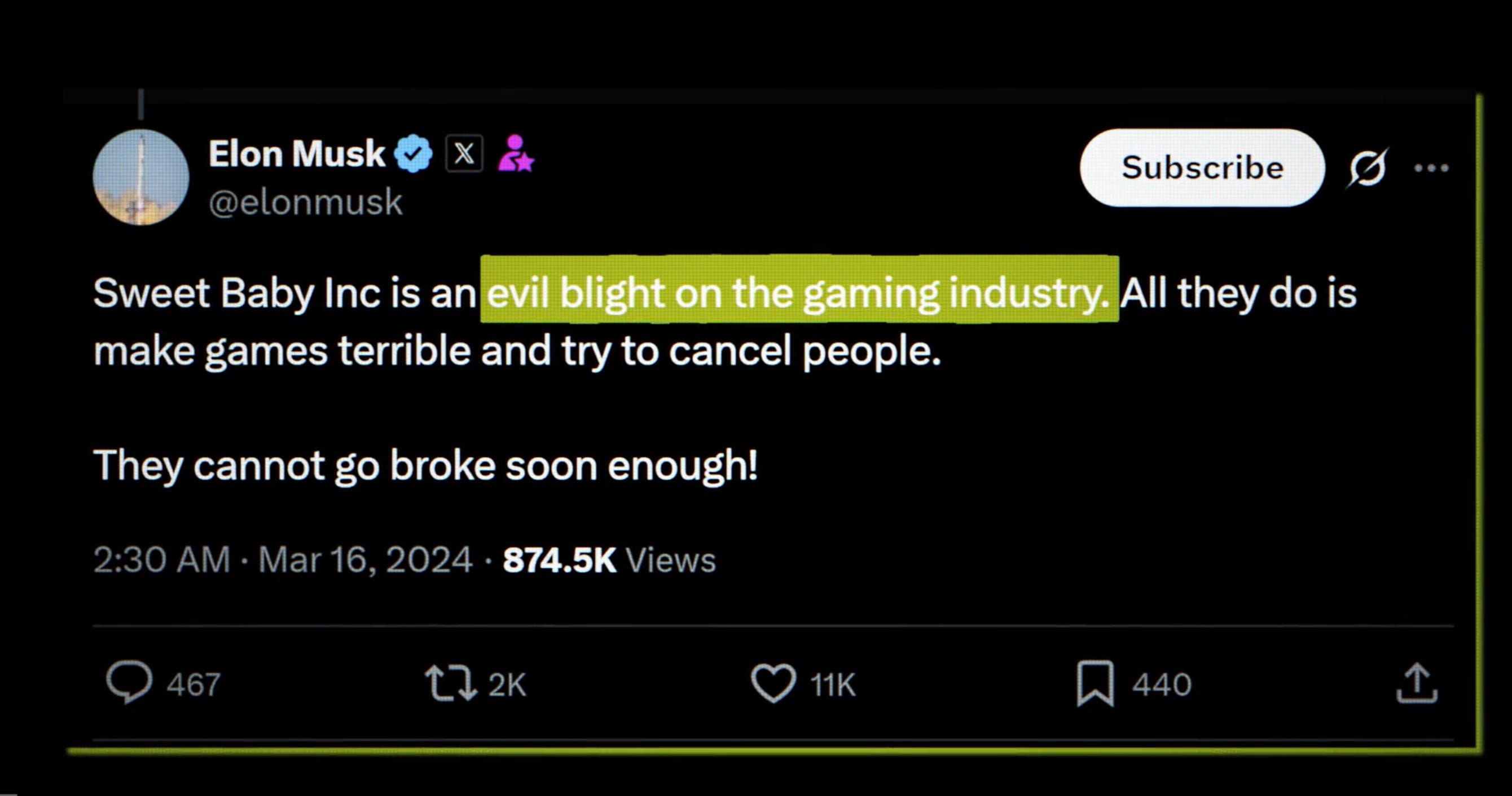
And then Elon Musk found it. The world’s richest man calling Sweet Baby straight up an “evil blight on the gaming industry.” Five words that turned a gaming controversy into global news. And Kim? She leaned into it.
”By day, I am the crazed CEO of Sweet Baby Inc., the DEI-obsessed censorship mafia who is currently ruining and woke-ifying all of the video games that you’ve ever played.”
Well, she wasn’t laughing. To her, this wasn’t criticism - it was a full-blown, coordinated harassment campaign. Death threats. Bomb threats. Her employees driven offline. And everyone kept saying the same thing: Sweet Baby is killing games.
“They will claim that you are rich, that you are backed by shadowy cabals, by government orgs. They claim you have the ability to force their favorite studios to bend to your whim, rather than the truth, which is that studios and teams hire us to make stories better”
Shadowy cabals. Government orgs. Her co-founder David Bedard found it almost amusing:
“[Detractors] would rather believe there’s a shadowy cabal forcing them to put this stuff in games. They’d rather believe a make-believe fairytale than accept the truth.”
A shadowy cabal controlling the industry? Not quite. But those 500,000 gamers tracking Sweet Baby? They were sniffing around the right tree. They just blamed the wrong branch.
GHOST IN THE SHELL
Meet Weird Ghosts. A Canadian fund that only invests in the ‘right’ kind of game studios. The kind where 50% of founders check a diversity box. Their nonprofit arm - Baby Ghosts - hands out $25,000 grants. Not for good games. Not for innovation. For demographics. One of their star recipients? Sweet Baby Inc. But here’s where it gets interesting. This isn’t some venture capitalist’s pet project.
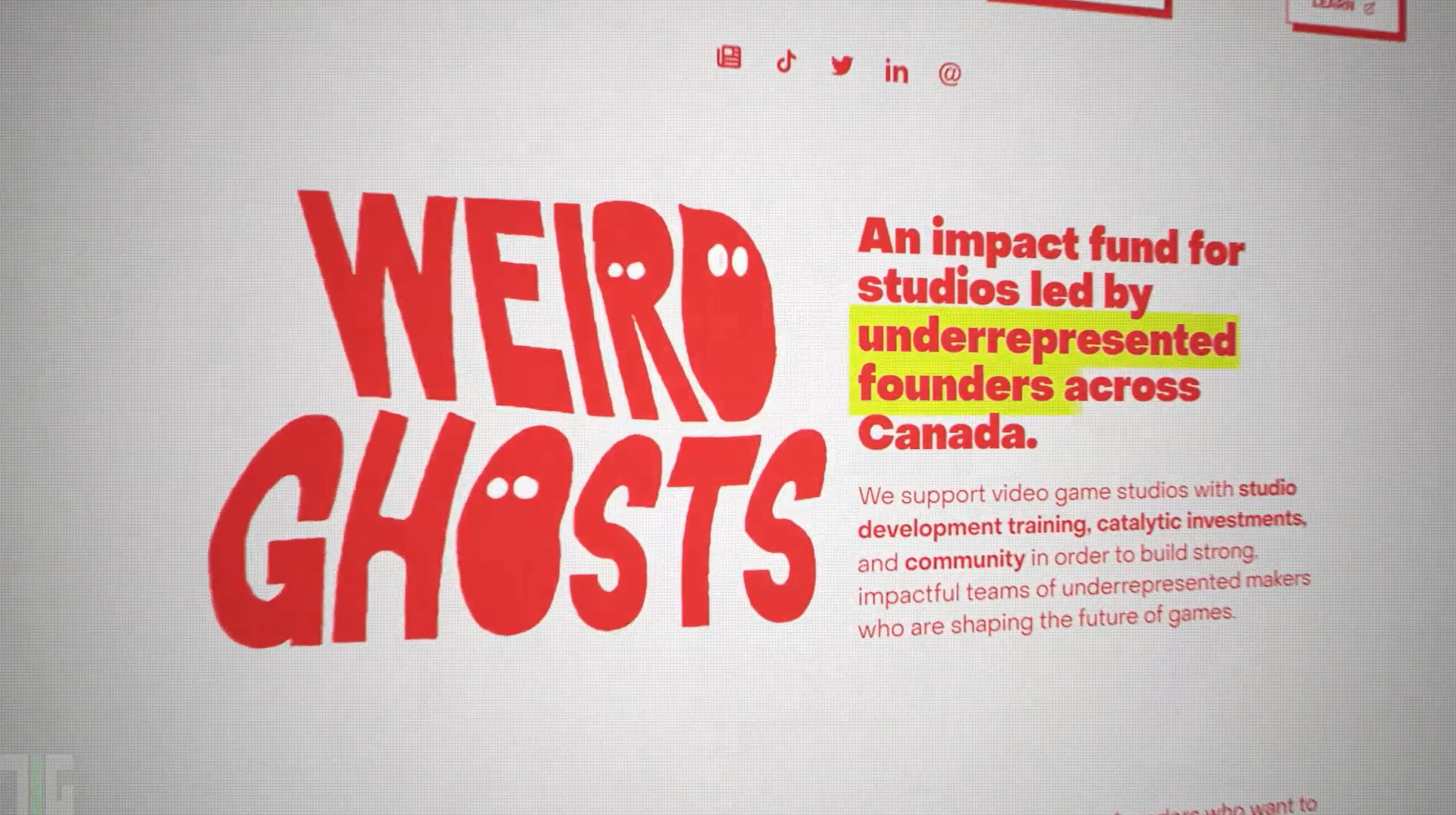
It’s your money. Tax dollars funding video game consultants.
No conspiracy. Just a paper trail anyone could follow. Government money → Weird Ghosts → Baby Ghosts → Sweet Baby Inc. A pipeline turning public funds into private ideology.
And the most ironic part? The people running this network are Gamergate veterans.
Remember 2014? When gamers accused the media of colluding to protect developers from criticism? When gaming journalists declared ‘Gamers are dead’ and the audience became the enemy? Those same journalists now run the funding network. Weird Ghosts. Baby Ghosts. Sweet Baby Inc.
So if you’re wondering why 500,000 gamers are still tracking Sweet Baby like it’s public enemy #1… it’s not about one tweet. Or one character. It’s because to them, Sweet Baby is just the final evolution of a system that declared war on its own customers.
But here’s the plot twist: The empire is crumbling.
Square Enix watched their profits crater 70%. Their response? Fire the consultants. New mission statement: ‘unforgettable experiences,’ ‘ensured fun,’ and a promise to ‘engage honestly’ with their players. In other words — less optics, more gameplay.
Even BlackRock is backing out. Larry Fink just admitted it cost his firm $4 billion. And he doesn’t even use the term anymore. “ESG has been weaponized by the far left and the far right,” he said. “I’m ashamed of being part of this conversation.”
Of course, Larry’s not giving up though. He’s just… rebranding.
“ESG investing seems to be getting a new look as the trend faced growing political criticism. But it seems there’s still a lot of excitement focused on the E in ESG — just under a new name: transition investing.”
Same religion. New branding.
And that - not Sweet Baby - that’s the real culprit in this game of thrones: BRANDING.
Because underneath every label is the same impossible promise: infinite growth in a finite world. But that’s an impossibility. You can’t sell more copies than there are gamers. Than there are hours in a day. Than there is money in wallets. But every quarter, investors want more.
So maybe the real transition we need… isn’t economic. It’s philosophical. Because gaming wasn’t supposed to need consultants and diversity scorecards. It was supposed to be simple and fun. An escape. With hot women, mysterious lore and games without pronouns, just bosses and blood.
And maybe—just maybe—that’s where we’re headed. Not because Sweet Baby failed. But because publishers remember that gamers aren’t ‘picky babies.’ They’re customers. And customers always win.